

Neonatal Care Leave: What Employers Need to Know
As of 6 April 2025, employees in England, Scotland, and Wales may be entitled to neonatal care leave and pay if their baby requires extended medical care shortly after birth. In August, the government published a technical guide which employers should be aware of and refer to when considering an employee’s leave or pay request. The technical guidance provides much needed clarification on the complex entitlement.
We’ve set out below some of the key points for employers to consider.
Eligibility criteria
For an employee to qualify for neonatal care leave, all of the following criteria must be met:
- The baby is born on or after 6 April 2025.
- The baby is admitted to neonatal care within 28 days after their date of birth.
- The baby receives seven full, continuous days of care (this may be either in hospital or consultant-led outpatient care).
- The employee has a parental relationship and is caring for the baby during the leave.
To also qualify for neonatal pay, employees must meet the criteria above and also the criteria for continuity of service and minimum earnings tests.
The government’s technical guidance has since provided further detail around these eligibility criteria.
The 28-day period
It is important to note when calculating the 28-day period that this begins the first full day after birth. For example, where the employee’s baby is born on 1 October 2025 at 2pm, the 28-day period begins on 2 October and the final day of the 28 days would be midnight on Wednesday 29 October.
Full and continuous seven days
Any care the employee’s baby receives must be for a full and continuous seven days. The first day of care is counted as the first full day after the baby is admitted, and the seven day period starts counting from midnight. If the baby is discharged before midnight at the end of the 7th day, the employee will not be entitled to accrue any leave or pay.
Example – if a baby is admitted on Sunday 20 April 2025 during the 28 days since birth, the seven full days will be completed at midnight on Sunday 27 April 2025. The first day that the parent could take neonatal care leave would be Monday 28 April 2025, and the parent would be eligible for one week of leave on that day.
Parental relationships
The entitlement is available to a broad range of parents, including the following:
- the biological mother, and their partner
- the biological father
- the adopter or prospective adopter (including overseas adoption), and their partner
- the intended parent(s) in a surrogacy arrangement
- the surrogate birth mother if they retain or regain responsibility for the baby.
Biological parents
Biological mothers and fathers are entitled to accrue leave or pay from the date of the baby’s birth.
Adoption
Adoptive parents are entitled to accrue leave or pay from the date the baby is placed with them for adoption, or for overseas adoption, the day the baby enters Great Britain. However, any period spent in neonatal care prior to the placement would not count towards accrual.
Partners
The partner of a parent is defined as someone who lives with them in an enduring family relationship but must not be related to them. A partner will only be eligible for leave or pay if they are in a relationship with the parent at the relevant time. For example, if the employee is the partner of the baby’s biological mother, they must have been their partner from the date of the baby’s birth. For an adopter’s partner, they must be their partner at the time of the baby’s placement, or with overseas adoption, the date the baby entered Great Britain.
It is important to note that partners of biological fathers will not be entitled to neonatal care leave or pay, unless they have or intend to apply for a parental order for the baby.
Types of neonatal care
A broad range of care is recognised as neonatal care, this includes hospital-based medical care, consultant-led outpatient care, and palliative or end of life care.
Transfers between hospitals, units or wards do not break continuity of care, however care must take place in Great Britain for the employee to be eligible.
How leave and pay is accrued
A parent will be entitled to a maximum of 12 weeks of paid leave which can be taken in seven-day blocks. Leave is accrued in arrears and must be taken within 68 weeks of the baby’s birth.
Overlapping care and multiple admission
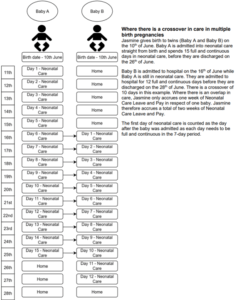
Where there are multiple births, for example twins or triplets, overlapping care of seven or more days will count as one entitlement period regardless of how many babies spend time in neonatal care. Where a baby has multiple admissions, but no overlapping care, this will be classed as separate entitlements, and an employee may have multiple periods of leave and pay.
Where there are separate pregnancies, for example where a biological father has two children from different relationships, entitlement to care and leave will accrue separately per period of neonatal care for each baby.
The guidance includes various helpful examples and diagrams such as the one set out below.
Information your employee must provide
In order to take neonatal leave or pay, an employee must give notice to their employer. Provided the correct notice is given, an employer cannot refuse an eligible request for leave or pay. Employers can choose to waive the requirement to give the required notice for neonatal care leave only, however, pay claims must be a written declaration.
Leave is separated into two tiers, tier 1 and tier 2, depending on when the employee is taking their leave or pay. The tier dictates the type of notice required.
Tier 1
Where leave/pay is taken while the employee’s baby is in care or the first week after leaving.
- Notice for leave doesn’t need to be in writing and an employee can provide notice informally (e.g. by phone or email).
- Notice for pay must be made in writing within 28 days.
Tier 2
Where leave/pay is taken more than one week after the baby has left neonatal care.
- Notice for leave and pay must be made in writing. The employee should state when they want their neonatal care leave to begin and how many weeks they are taking.
Where an employee requests one week of pay, notice must be given within 15 days before the first day of the pay week. Where an employee requests two or more consecutive weeks of pay, notice must be given within 28 days before the first day of the pay week.
For any pay request or tier 2 leave, employees must set out the information found at page 13 of the employer’s technical guidance. No documentary evidence is required to take leave or pay, and employers should not request this from an employee.
Interaction with other types of leave
When considering any entitlement to neonatal care leave, employers should also consider any other leave.
- Maternity leave cannot be stopped and restarted, and so neonatal care leave should be taken after maternity leave ends.
Example – A mother’s baby is admitted into neonatal care from birth and stays for 16 days, for which she accrues two seven-day periods of neonatal care leave and pay. Her maternity leave starts on the day the baby is born and continues for 52 weeks. She then tags on two weeks of neonatal care leave and pay at the end of her maternity leave.
- Paternity leave can be taken before or after neonatal care leave.
- Shared parental leave can be taken before or after neonatal care leave.
- Adoption leave cannot be stopped and restarted, and neonatal care leave should be taken within 68 weeks of birth, not placement.
Example – Robyn is adopting a baby. The baby went straight into neonatal care at birth and is receiving neonatal care at the point they are placed with Robyn for adoption. The baby is placed with Robyn when they are eight weeks old, and they go on to spend a further 12 weeks in neonatal care.
Robyn accrues neonatal care leave and pay for the 12 weeks after the baby is placed with her. While Robyn wants to take the full 52 weeks of Adoption Leave with the 12 weeks of neonatal care leave, this will not be possible. Neonatal care leave must be taken within 68 weeks of the baby’s birth date, not placement date. Robyn must consider the best way to take her adoption leave and neonatal care leave, and at which point to end her adoption leave to start her neonatal care Leave.
- Parental bereavement leave may be taken alongside neonatal care leave if an employee’s baby passes away.
The implications for employers
- Cost and resource considerations – With more parents potentially taking up to 12 additional weeks of leave, employers may face increased staffing costs to cover absences, especially in smaller teams.
- Administrative and policy updates – Employers should update all of their relevant policies and procedures, making sure they clearly and adequately set out their new neonatal care leave duties. Neonatal leave guidance should sit alongside existing parental leave policies and clearly outline the new entitlements and processes for both employees and managers.
- Legal risk and return-to-work obligations– Employers must also be mindful of the legal protection employees have while on neonatal care leave. Staff returning after up to 12 weeks are entitled to return to their role. If this is no longer feasible, an equivalent position or priority consideration for other suitable roles must be offered. Additionally, employees are protected from redundancy, dismissal, or any detriment due to taking neonatal care leave—failure to comply could result in legal action.
Key takeaways for employers
When managing an employee’s neonatal care pay or leave, consider these key points and utilise the employer’s technical guidance where necessary:
- Confirm eligibility, considering the baby’s birth date, care duration, and the employee’s employment status.
- Track neonatal care dates and ensure the seven full days of continuous care is met.
- Request written declarations for pay claims.
- Record leave/pay periods and retain documentation for three years for HMRC.
- Coordinate leave with an employee’s other entitlements (e.g. maternity, paternity leave).
- Support employees compassionately, especially during the first week of care when leave may not yet be accrued and consider offering other types of leave in the meantime e.g. unpaid parental leave, emergency leave, or annual leave.
- Review and revise internal HR policies to reflect the Neonatal Care (Leave and Pay) Act 2023.
- Train managers and HR staff on the new entitlements and obligations.
- Ensure payroll systems can accommodate statutory neonatal pay accurately.
- Prepare for staffing adjustments during periods of extended leave.
- Communicate clearly with employees about their rights and the process to request neonatal care leave.
How we can help
Our expert employment solicitors are on hand to support you with this legislation. Whether you need assistance updating your policies, or managing requests, we provide practical, commercial advice tailored to your business.