

Court Of Appeal Invalidates “Uncertain” Patent and Rejects “Schrödinger’s Patent Infringement” Claim in Dual Outlet Electric Shower Dispute


13th February 2026
Legal analysis of KOHLER MIRA LIMITED -v- NORCROS GROUP (HOLDINGS) LIMITED [2025] EWCA Civ 1670
[Disclaimer: We (Shakespeare Martineau LLP) represented the successful defendant/appellant in these proceedings.]
The Court of Appeal has unanimously reversed the 2024 decision of the Intellectual Property Enterprise in [2024] EWHC 3247 (Ch), by finding that the Kohler Mira Limited (“Mira”) patent in suit is both invalid and, even had it been valid, that it would not be infringed by Norcros Group (Holdings) Limited (“Triton”)’s DuElec shower range.
The judgment is available to read here.
The patent and the relevant claims
Mira contended that claims 1, 4 and 17 of the patent were independently valid, and claims 1 and 4 were infringed. These are reproduced below, broken down into the integers as agreed by the parties:
Claim 1:
“[a] An instantaneous water heater having
[b] a heater tank to heat water flowing through the tank, and
[c] a diverter valve downstream of the heater tank to select at least one outlet from at least two outlets and direct water from the heater tank to the selected at least one outlet,
[d] wherein the diverter valve is configured so that flow rate is substantially unchanged during changeover from one or more selected outlets to another selected one or more outlets.”
Claim 4:
“An instantaneous water heater according to any preceding claim wherein the diverter valve cannot be positioned to prevent water flow.”
Claim 17:
“An instantaneous water heater according to claim 1 wherein there are more than two outlets with the diverter valve directing water to each outlet individually or to a combination of two or more outlets simultaneously.”
Maintaining flow rate is crucial in electric showers, as it is the flow rate of water over the heated elements which ultimately determines the temperature of the water. The slower the flow rate, the warmer the temperature and vice-versa. This was all part of the common general knowledge at the Patent’s priority date.
The claimant proposed the following construction of Integer 1d of claim1, which was accepted by the first instance trial judge:
- the specified result (substantially unchanged flow rate) need not be achieved by the diverter valve, and
- the flow rate is “substantially unchanged” if, when water is flowing at a selected water temperature while the heater is energised, any increase in temperature during changeover from one or more selected outlets to another selected one or more outlets does not give rise to a risk of scalding (“the risk of scalding criterion”).
The defendant’s products
The DuElec range of products are dual outlet electric showers, with a handheld shower outlet and an overhead ‘rainfall’ effect showerhead.
As well as having an instantaneous water heater to heat the water, two outlets and a diverter valve, the products also have:
i) A flow stabilisation valve to automatically regulate the flow rate of water entering the water heater in response to changes in water pressure, to keep the flow of water constant in the system.
ii) A thermal cutoff, which measures the temperature of the heated water and cuts off the electricity supply to the instantaneous water heater if it rises too high.
Construction and the meaning of “substantially unchanged”
Triton’s grounds of appeal focussed first on aspects of how the claims in suit were to be construed.
An important finding, overlooked by the first instance judge, was that claim 1 is not limited to use with domestic showers – it is for any instantaneous water heater with the components . The judgment gives examples of dishwashers and pressure washers with multiple outlets, which could fall within claim 1.
Once the court accepted that claim 1 covered instantaneous water heaters that could be used in products other than just electric showers, the construction of the words “substantially unchanged” in relation to flow rate contended for by Mira, namely the “risk of scalding criterion” could not work. Arnold LJ observed:
“It follows that it must be possible to determine whether or not any particular instantaneous water heater falls within claim 1 or not without reference to any larger apparatus in which the instantaneous water heater may be incorporated or may be intended to be incorporated. Contrary to the submission of counsel for Mira, infringement of claim 1 cannot depend on the use, or intended use, of the instantaneous water heater.”
In applications such as a dishwasher or a power washer, scalding the user is not necessarily a concern, and indeed, it may be positively desirable for scalding hot water to be used. Mira’s construction could therefore not be the correct one.
Infringement
Integers 1a to c of claim 1, and claim 4 were admitted to be present in the Triton DuElec products. Claim 17 was not alleged to be infringed.
The question at trial was therefore whether the DuElec diverter valve is “configured so that flow rate is substantially unchanged during changeover from one or more selected outlets to another selected one or more outlets.” This discussion is subject to the criticisms and uncertainty of this wording used in the Claim as discussed in relation to validity of the Patent and construction.
The diverter valve used in the DuElec range is illustrated below.
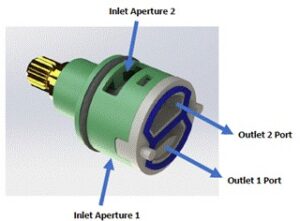
As a result of the interaction between the shapes of the flap within the valve which turns in use and the outlets, there is not a linear and gradual progression from outlet port 1 being open to outlet 2 port being open. Instead, the combined cross-sectional area of the open outlets varies significantly during changeover, so that at one point it is only about a third of the area of a fully open outlet port. This is shown in the below diagram, accepted by the parties:
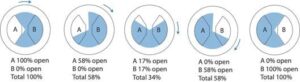
This reduction in the cross-sectional area of the outlets during changeover does not however affect the overall flow rate through the Triton shower system, as the DuElec flow stabilisation valve regulates the flow rate and always contains the smallest cross-sectional area in the system, even after the restrictions on the flowpath that the valve design introduces.
The court found that such a valve cannot be said to be configured so that flow rate is substantially unchanged during changeover from one or more selected outlets to another selected one or more outlets for the purposes of claim 1 (and therefore also claim 4).
First, although Triton admitted that the products satisfy the “risk of scalding criterion” for determining whether the flow rate is “substantially unchanged”, this is due not to the design of the diverter valve in any event, but to the flow stabilisation valve and the thermal cutoff.
The court agreed with Triton’s argument that “the diverter valve is configured so that” means that it is the diverter valve which must achieve the specified result.
The court rejected Mira’s argument that the configuration of the valve must be considered in conjunction with components of any larger assembly into the instantaneous water heater may be, or may be intended to be, incorporated e.g. the flow stabilisation valve and thermal cut-out.
This sensible finding means that, contrary to Mira’s case, infringement of claim 1 cannot depend on the use, or intended use, of the instantaneous water heater, and what further components (not mentioned in the patent) are to be potentially added later. Otherwise, precisely the same instantaneous water heater/valve/outlet combination could be both infringing and non-infringing – with the court approving Triton’s argument that this would be like “Schrödinger’s patent infringement”.
In any event, the court rejected Mira’s “risk of scalding criterion” as discussed above, and no other criterion was proposed by Mira by way of an alternative case, so the court had no other basis on which to make a finding of infringement.
Mira’s case on equivalents was also grounded on the concept of avoiding a “risk of scalding”, so this argument also failed.
Validity
Having construed the patent and found it not to be infringed, The Judge turned to the question of validity.
At first instance the patent had been held not to be obvious, and the insufficiency attack were dealt with lightly but nevertheless in Mira’s favour. As is well known by practitioners in this field, overturning a finding on obviousness is notoriously difficult before an appellate court, primarily because such a finding is one of fact. However, Arnold LJ dextrously bypassed that finding by focussing rather on the question of insufficiency by uncertainty. This followed naturally from his findings on construction. He said:
“This Court held in Anan Kasei Co Ltd v Neo Chemicals & Oxides Ltd [2019] EWCA Civ 1646, [2020] FSR 8 that a patent is invalid on this ground if a term used in the claims is uncertain, so that it is not possible to determine what is within the claims and what is not.
Arnold LJ relied on the same reasoning that had supported his earlier finding that the DuELec did not infringe in finding the patent uncertain and therefore insufficient:
[I]t is common ground that the specification of the Patent does not explicitly provide any criterion for determining whether the flow rate is “substantially unchanged”. The only criterion proposed by Mira is the risk of scalding criterion, which I have rejected. No other criterion has been proposed by Mira by way of an alternative case. In those circumstances it follows that claim 1 is insufficient because the boundary of the claim is impossible to determine. Is a 1% change in flow rate within the claim? 5%? 25%? 50%? The skilled person would have no idea.
Having a clear basis for determining whether a product (or process) infringes a patent claim is of course highly relevant as between litigants. But it is equally relevant to interested third parties, as is recognised in the protocol on interpretation of patents. The fact the skilled person would have “no idea” how to determine the boundary of the claim as Arnold LJ explains led directly to his finding of invalidity by insufficiency. Mira had argued this case was an example of a “fuzzy boundary”, which Arnold LJ recognised would have been acceptable, but his finding of “no idea” meant Mira’s patent had a claim boundary whose location was impossible to determine.
Having made this finding, Arnold LJ observed that it was not necessary to consider the question of obviousness.
Practical tips arising from the decision
- When drafting a patent, carefully consider how wide you wish the scope to cover. Here, the fact that claim 1 covered more than shower products was crucial to the finding of invalidity, as the claimant’s desired construction of “substantially unchanged” that was constructed to capture the defendant’s product did not work beyond considerations in the shower arena.
- A court will look to the purposes of a patent to help guide construction. Here the court considered that you need to be able to determine infringement by looking at the elements specified in the claim (for example when sat on a shelf), and not have to consider how those components could then go on to be used in a wider system.
- Fuzzy boundaries in patent claims are permitted, but the patent must give some guidance to allow determination of the scope of protection. Here, there was no guidance as to how much flow rate could be changed as a result of use of the diverter valve, to still be an infringing product.
- Carefully select which patent claims you wish to assert as independently valid and infringed in patent litigation. Here the claimant did not select claim 19, which was limited to showers which include the claimed instantaneous water heater. This is particularly the case in IPEC, where the claimant is typically restricted to selecting a maximum of three claims.
This content is provided for general informational purposes only and does not constitute legal advice. It is not intended to address the circumstances of any individual or entity, nor should it be relied upon as a substitute for specific advice from a qualified solicitor. The information reflects the legal position as at the date specified and may be subject to change. If you require advice on a specific matter, please contact us directly.
Our latest intellectual property content

Acas Publishes Revised Draft Code of Practice on Disciplinary and Grievance Procedures: What Employers Need to Know
The Employment Rights Act 2025: A Focus on the Fair Work Agency
Five Website Compliance Risks Your Organisation Can’t Afford to Ignore
See more articles >



Our legal experts are here to answer any question you might have
If you’d like to speak to a member of our team, please fill out the form and we’ll be in touch within two hours.
If you know who you need to contact, you will find a full list of our people with email and telephone numbers here.
Call Us: 0330 024 0333
About the Authors

Nicholas Briggs
Partner & Head of Intellectual Property

Daniel Kelly
Legal Director